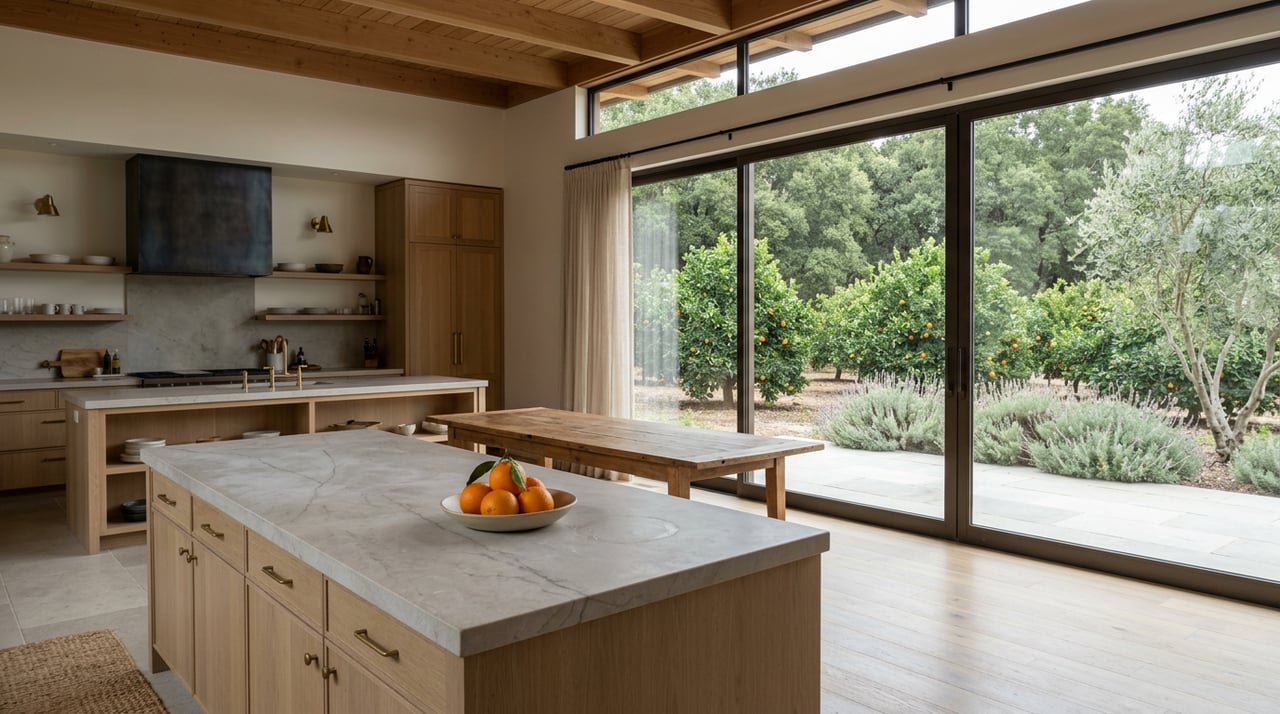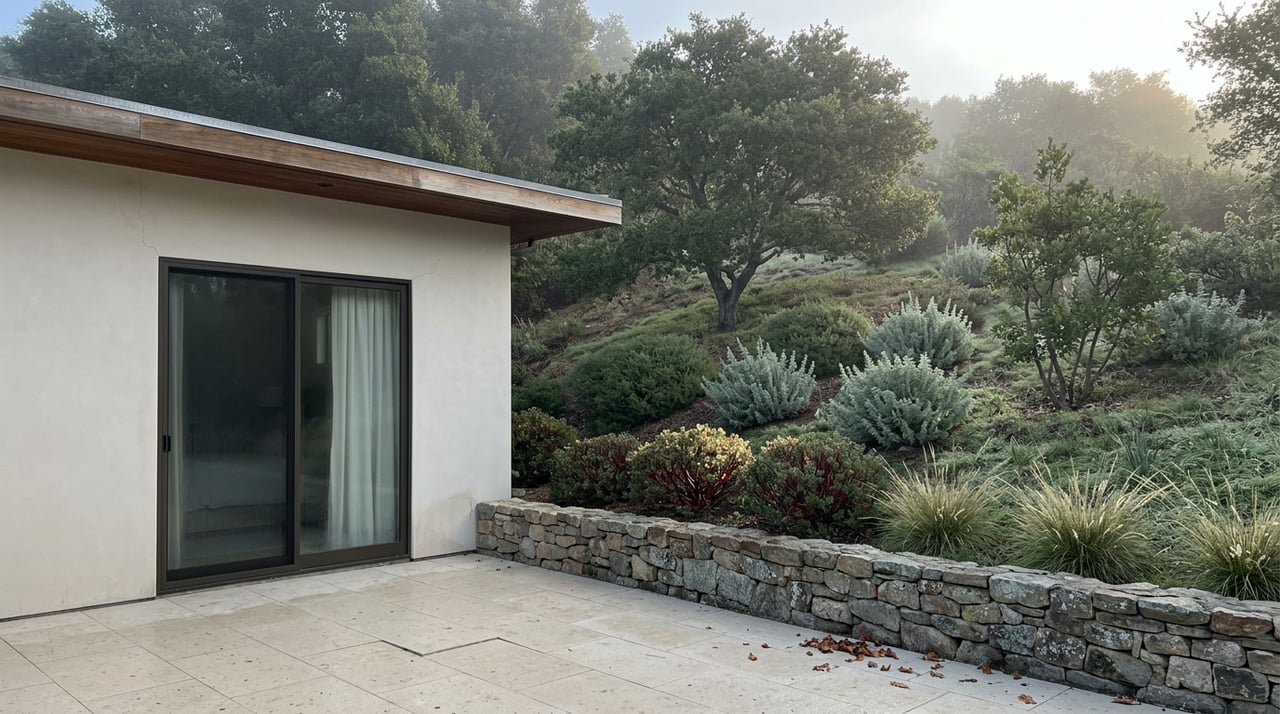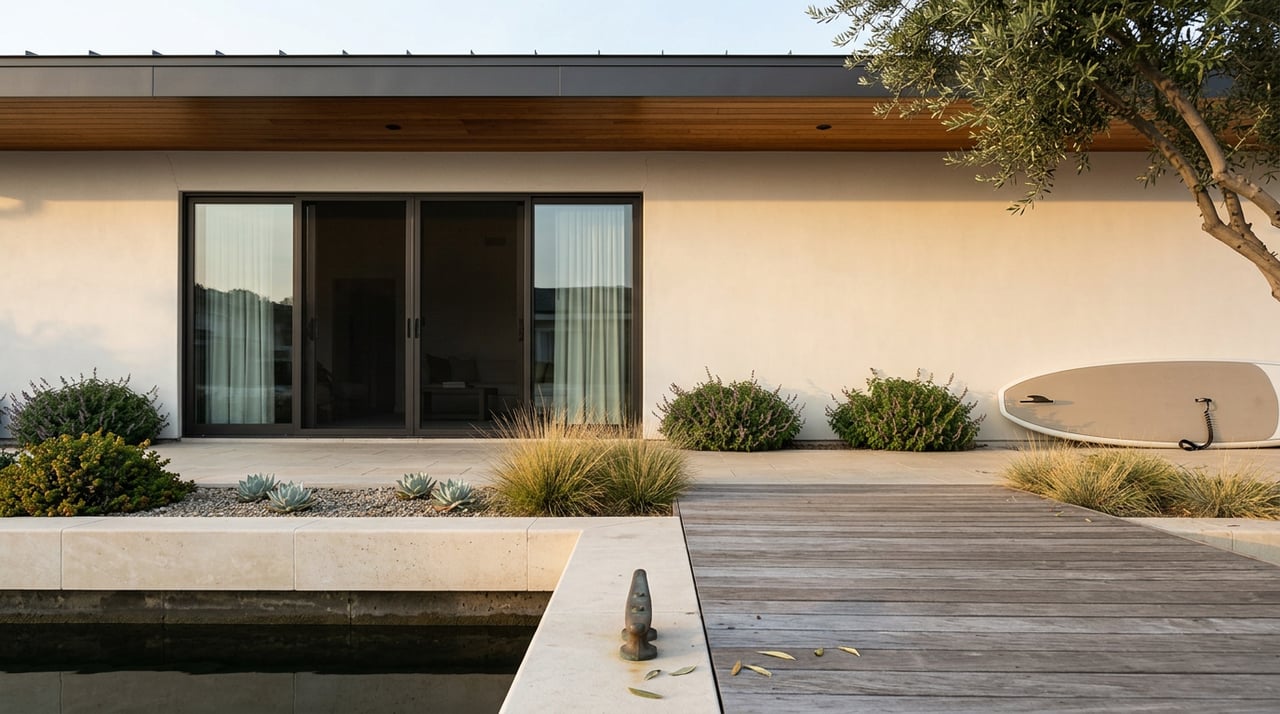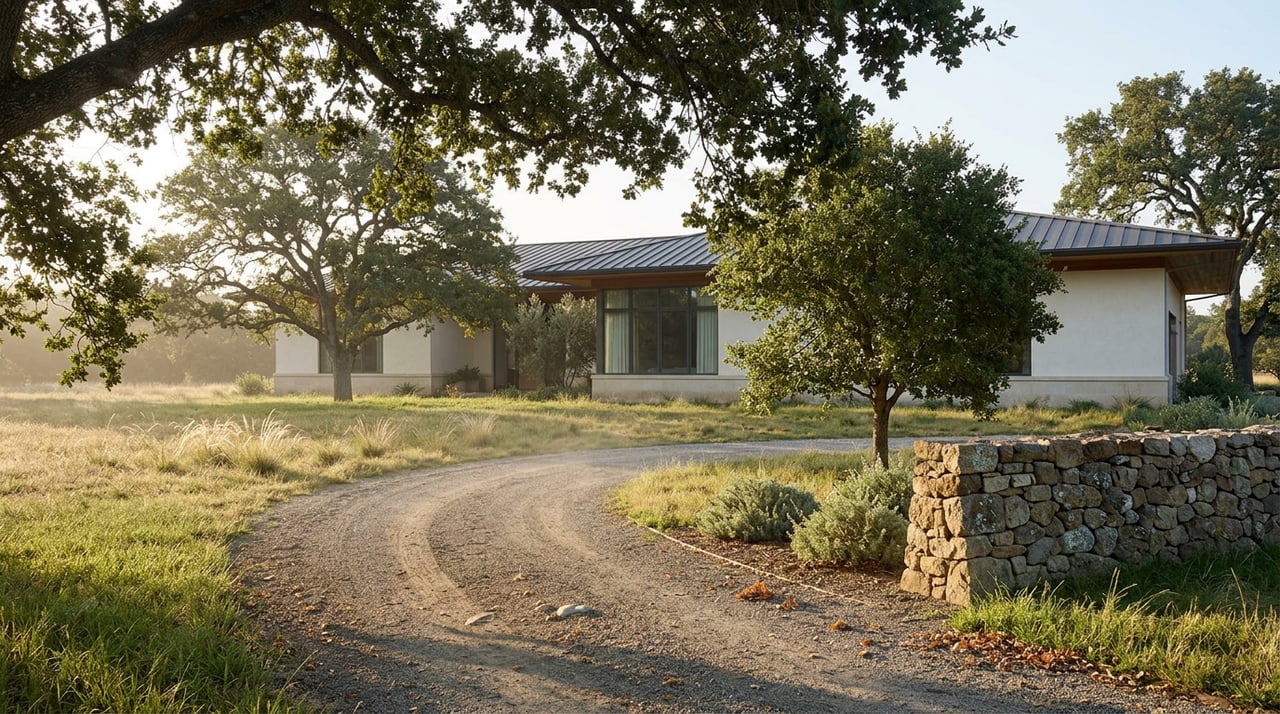
If you've spent any time searching for homes in Ojai, you've already seen the number. It shows up first on every portal, gets quoted in every market summary, and anchors most people's sense of what a house here costs. As of May 2026, the median price for a single-family home across Ojai was $1,144,750, with sale-price data for the three months ending that April placing the citywide median closer to $1.2 million. Either number is accurate. Both are close to useless if you're looking at Persimmon Hills.
Walk the three streets that make up this enclave, Buckboard Lane, Longhorn Lane, and Saddle Lane, and you're in a different market entirely. As of this summer, the active listings there ranged from $5.95 million for a five-bedroom home on Saddle Lane to $10.45 million for a property whose address is kept private. Nothing in that range resembles the citywide median. The gap isn't a rounding error. It's a signal that Persimmon Hills doesn't behave like the rest of Ojai's housing stock, and understanding why matters more than the median itself if you're trying to buy or sell here.
The Enclave the Median Wasn't Built to Describe
Persimmon Hills sits on land that was once a working dairy farm. When it was subdivided into a residential community, the developers laid out just three roads, with distinct entrances and no through traffic connecting to the surrounding grid. The neighborhood is bordered by Soule Park Golf Course to one side and tree-canopied Creek Road to another, both of which limit how the enclave can expand or infill. That layout wasn't designed with density or turnover in mind. It was designed for privacy, and it has held that shape for decades.
A citywide median works by averaging a large, varied pool of transactions, half-acre bungalows near downtown, small ranch homes in Mira Monte, condos, and everything in between. Persimmon Hills never contributes much volume to that pool. With only three streets and parcels that rarely change hands, there simply aren't enough sales here to move the citywide number, and there aren't enough comparable sales within the enclave itself to price a new listing off a clean trend line. Every transaction in Persimmon Hills is closer to a one-off than a data point.
Here's what that looks like side by side:
| Ojai citywide (as of May 2026) | Persimmon Hills (current listings) | |
|---|---|---|
| Typical price | roughly $1.14M–$1.2M | roughly $5.95M–$10.45M |
| Typical lot size | under half an acre is common | 3 to 4 acres is typical |
| Water and sewer | municipal hookups are standard | private wells and septic systems are common |
The lot size and utility rows explain more about the price gap than the sale price row does. That's the part worth sitting with.
What the Dairy Farm Left Behind
Because Persimmon Hills predates a lot of the municipal infrastructure that now serves downtown Ojai, many of its estates still run on private wells and septic systems rather than city water and sewer. One home on Buckboard Lane, which last sold in 2015, was marketed specifically around a private well and solar array that eliminated its water and electric bills entirely. That's not a quirky selling point. It's a structural feature of buying into this enclave, and it changes what due diligence looks like compared to a typical in-town purchase.
If you're evaluating a property here, or preparing one to sell, the questions that matter most rarely come up in a standard Ojai transaction:
- What does the well's flow rate test show, and how has it held up in dry years
- When was the septic system last inspected or pumped, and what's its remaining capacity
- Are there documented water rights attached to the parcel, separate from the land title itself
None of this shows up in a median price chart. All of it shows up in escrow, usually right when a buyer or seller least expects a delay.
What a $4.5 Million Spread Actually Buys
Look closer at the current listings and another pattern emerges. The home at 291 Saddle Lane is roughly 5,354 square feet and priced at $5.95 million. Not far away at 741 Saddle Lane, a 6,000 square foot home is listed at $8.23 million. Both are five-bedroom homes on the same street, and the size difference between them is modest, about 650 square feet. The price difference is $2.28 million.
That's not how price-per-square-foot is supposed to work in most markets. When two comparable homes on the same street carry a multi-million dollar gap despite similar footprints, the square footage isn't what buyers are paying for. They're paying for the acreage, the privacy from the road, the quality and orientation of the mountain views, the equestrian facilities, and the specific way a property sits inside those three streets. A buyer comparing these homes purely on cost per square foot will misread the market every time.
The pattern holds even before construction. As recently as 2021, a bare 2.54-acre parcel on Longhorn Lane, with only preliminary permits submitted and no house built yet, sold for $950,000. That's raw, unimproved land commanding nearly a million dollars, which tells you the scarcity here starts with the acreage itself, long before anyone breaks ground.
Why This Matters More If You're Selling
If you own a home in Persimmon Hills and you're thinking about listing it, pulling Ojai's citywide comps to set your number will lead you astray in either direction. Price too close to the citywide median and you leave real value on the table. Price purely off square footage against the other Saddle Lane listing and you might miss what buyers here are actually weighing: acreage, water infrastructure, privacy, and the kind of quiet that three self-contained streets with no through traffic can offer.
This is also where marketing has to work differently. A buyer for a $9 million estate in a three-street enclave isn't scrolling generic listings. They're often relocating from out of state, comparing this neighborhood against comparable properties in Montecito or the Santa Barbara foothills, and they expect materials, photography, and positioning that reflect the property's actual scarcity rather than its square footage.
That's the kind of pricing and marketing conversation worth having before a home goes on the market, not after the first offer comes in low. If you're weighing a sale here, a home valuation that accounts for the enclave's actual comps, rather than Ojai's broader averages, is the more useful starting point than any portal estimate.
A Few Questions Worth Asking Before You Look Further
Do all Persimmon Hills homes run on private wells? Not every parcel, but private wells and septic systems are common enough that it's worth confirming utility infrastructure early in any showing or listing conversation rather than assuming municipal hookups.
Why are there so few comparable sales to work from? The enclave has only three streets and a limited number of parcels that were laid out decades ago on the former dairy farm site. Turnover is naturally low, and that scarcity is part of what supports the price range in the first place.
Is Soule Park Golf Course actually adjacent to the neighborhood? Yes. Persimmon Hills borders Soule Park Golf Course, a Ventura County-owned course, along one edge, with Creek Road forming another boundary.
If you're evaluating a property in Persimmon Hills, whether you're buying into it or preparing to list one of its estates, the details that matter most rarely show up in a citywide market summary. Gabriela Ceseña works this enclave street by street, not median by median. Schedule your consultation to talk through what your specific property, or your specific search, actually calls for.